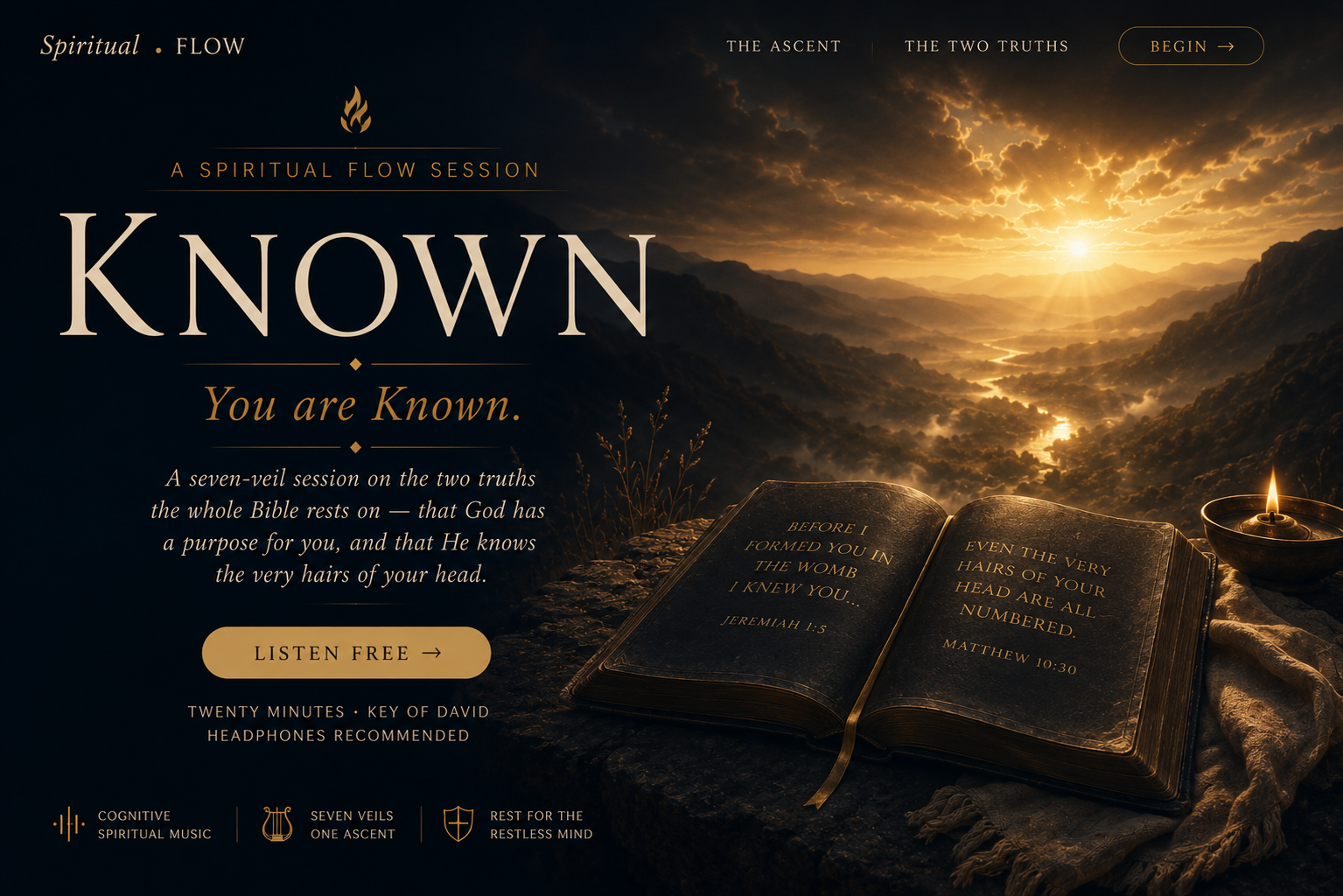
Cognitive Spiritual Music™
Ancient harmonies designed to wrap around you, guiding your spirit to a place of rest.
Spiritual.Flow
Rest for the Restless Mind
ABOUT THE MUSIC
What it is.
Where it comes from.
This is not meditation music.
It is not brain entrainment.
It is something much older, recovered, refined,
and placed in service of the one thing it was always meant for.
The first thing to say is what this music is not.
It does not use binaural beats, the technique of playing slightly different frequencies in each ear to produce a perceived pulse the brain is asked to follow.
It does not use isochronic tones, subliminal frequencies, or any mechanism designed to impose a state on the listener from outside.
If you have heard concerns from fellow believers about music that manipulates the mind, those concerns do not apply here.
We share them.
We have built something different.
What we have built begins with a question that was answered three thousand years ago, then forgotten, then recovered by an Estonian composer in Soviet exile, then given its scientific explanation by a physicist at IBM.
The question is this: why do certain sounds settle a tormented mind?
THE ANCIENT ANSWER
David already knew.
"And whenever the tormenting spirit from God troubled Saul, David would play the harp. Then Saul would feel better, and the tormenting spirit would go away."
1 SAMUEL 16:23 · NLT
This verse is not a metaphor or a narrative detail.
It is documentary evidence, the oldest recorded account of music being used deliberately and successfully to settle a mind in distress.
A young shepherd, raised in the fields of Bethlehem, discovered something about sound and the human soul that science would spend the next three millennia trying to explain.
David did not stop at the harp. He also wrote the Psalms, the prayer book of Israel, the liturgical core of the early church, the source literature of three thousand years of Christian worship.
The same man who discovered that music could settle Saul also gave us the vocabulary for every posture of approach to God.
Stillness, reverence, thanksgiving, praise, surrender, beholding, communion.
Seven postures, and a sequence.
THE RECOVERED TRADITION
Eight years of silence.
In 1968, the Estonian composer Arvo Pärt wrote a piece of sacred music, the first overtly Christian composition of his career. The Soviet regime censured him for it. His music disappeared from concert halls.
Facing a creative crisis and a collapsing musical language, he made a decision that would change the history of sacred music: he stopped composing, and spent eight years studying the roots of what had come before.
He studied Gregorian chant, the unaccompanied single-voice singing of the early church, built directly from the natural rhythms of Latin speech.
He studied the Notre Dame School, a group of composers working in twelfth and thirteenth century Paris who first worked out how to weave multiple voices together over a sustained drone.
He studied early polyphony. He converted to Orthodox Christianity. And from those years of silence and study, he emerged in 1976 with something he called tintinnabuli, Latin for little bells.
The Tintinnabuli Method is disarmingly simple.
One note moves as a melody, step by step.
A second holds the notes of a single chord and never departs from it.
The harmonic tension that most music depends on to generate interest is absent.
There is no chord that demands resolution.
There is only a stable foundation and a melody that rises and falls above it, like breathing.
The result sounds ancient because it is ancient.
Pärt did not invent a new technique. He recovered one that the church had practised for a thousand years and that modernity had set aside.
His most well-known piece, Spiegel im Spiegel "Mirror in the Mirror" written in 1978, holds a single F major chord in the piano for ten minutes while a violin traces ascending phrases above it, each one a mirror of the last.
People who encounter it for the first time often describe the experience in words they normally reserve for prayer: stillness, presence, the sense of being held.
They are not wrong about what they are experiencing.
They are simply hearing what sacred music sounds like when the composer gets out of the way and lets the ancient pattern speak.
THE SCIENTIFIC EXPLANATION
The brain was made for this.
In 1975, a physicist named Richard Voss at IBM's research laboratory made a discovery that explained, in mathematical terms, why music like Pärt's works the way it does.
Studying the statistical properties of sound, Voss found that the loudness and pitch fluctuations of great music, across cultures, across centuries, from Bach to folk song to sacred chant, follow what physicists call a 1/f distribution.
The pattern is self-similar at every scale. What happens in the first second resembles what happens in the first minute resembles what happens across the whole piece.
This is the definition of a fractal.
The name for this statistical pattern is pink noise. It sits precisely between two extremes: white noise, which is entirely random and unpredictable, and brown noise, which is so correlated and repetitive that it becomes meaningless.
Pink noise is neither chaotic nor monotonous. It is ordered variation, structured at every scale simultaneously, and the human brain finds it effortless to process.
Not because we have been trained to prefer it, but because the brain itself runs on it.
Electroencephalography, the measurement of electrical activity across the brain, shows that healthy brain wave fluctuations follow the same 1/f pattern.
The brain is, in its own electrical activity, a fractal system. And it responds to fractal sound the way it responds to its own native language.
This is why rain is settling.
Why the sound of a river quiets an agitated mind.
Why wind through trees has been the backdrop of prayer and contemplation across every culture in history.
These are not sentimental associations. They are 1/f systems meeting a 1/f brain and finding resonance. Gregorian chant has the same property, built on the natural rhythms of speech, which are themselves 1/f, it carries fractal statistics in its structure.
This is almost certainly why centuries of monks described choral prayer as settling their souls: the acoustic mathematics matched the mathematics of their own minds.
What we do not do is impose a frequency from outside and instruct the brain to follow it.
That is the binaural beats model, external mechanism, external target, external instruction.
What we do instead is compose music whose statistical character already matches the brain's native structure, so the brain encounters it not as a command but as a recognition.
This is not manipulation. It is resonance.
The distinction matters, theologically and scientifically.
WHAT WE BUILD WITH
The decisions behind every sound.
Every compositional choice in a Spiritual Flow session serves the same purpose: to remove what stands between a settled mind and the One who already lives within it.
That purpose governs everything.
We compose on a sustained root note that does not change.
We choose instruments with the slowest attack envelope available and tones that arrive like breath rather than like strikes.
The brain's alerting system notices edges.
We remove the edges.
We embed an audible breath cadence at approximately five and a half seconds per cycle, the rate at which heart rate variability and respiratory rhythm come into phase coherence. The clinical literature calls this resonant breathing.
The listener does not have to count or track it. The breath is in the music. The body finds the rhythm within the first minute and follows it without being told to.
WHAT THIS IS NOT FOR
We are not emptying your mind.
This is where Spiritual Flow departs most sharply from almost everything else in this space.
The goal of most meditation practice, and most music designed to accompany it, is the empty mind: the cessation of thought, the dissolution of self, the arrival at a consciousness without content.
That is a spiritual goal within certain traditions.
It is not ours.
We are not trying to empty your mind.
We are trying to quiet it.
The distinction is not subtle. A quiet mind is not an absent mind. It is a receptive one, stilled from its own noise, freed from the accumulated cognitive weight of the day, capable again of the attention and presence that Scripture, prayer, and encounter with God require.
The reason this matters is theological. The believer is not an empty vessel waiting to be filled by a generic spiritual presence.
The believer is already indwelt.
The Holy Spirit already lives within the regenerated spirit.
The problem is not absence, it is noise.
The mind is so full of its own chatter that it cannot hear what is already speaking from within.
"Come to me, all you who are weary and burdened, and I will give you rest."
MATTHEW 11:28 · NIV
This is the promise the music is designed to make accessible. Not to produce the rest by itself, music cannot do that. But to remove what prevents the listener from receiving what is already being offered.
The session ends.
The encounter does not.
The listener is guided in to Prayer, Scripture, or Communion.
TRACK ONE - COMING SOON
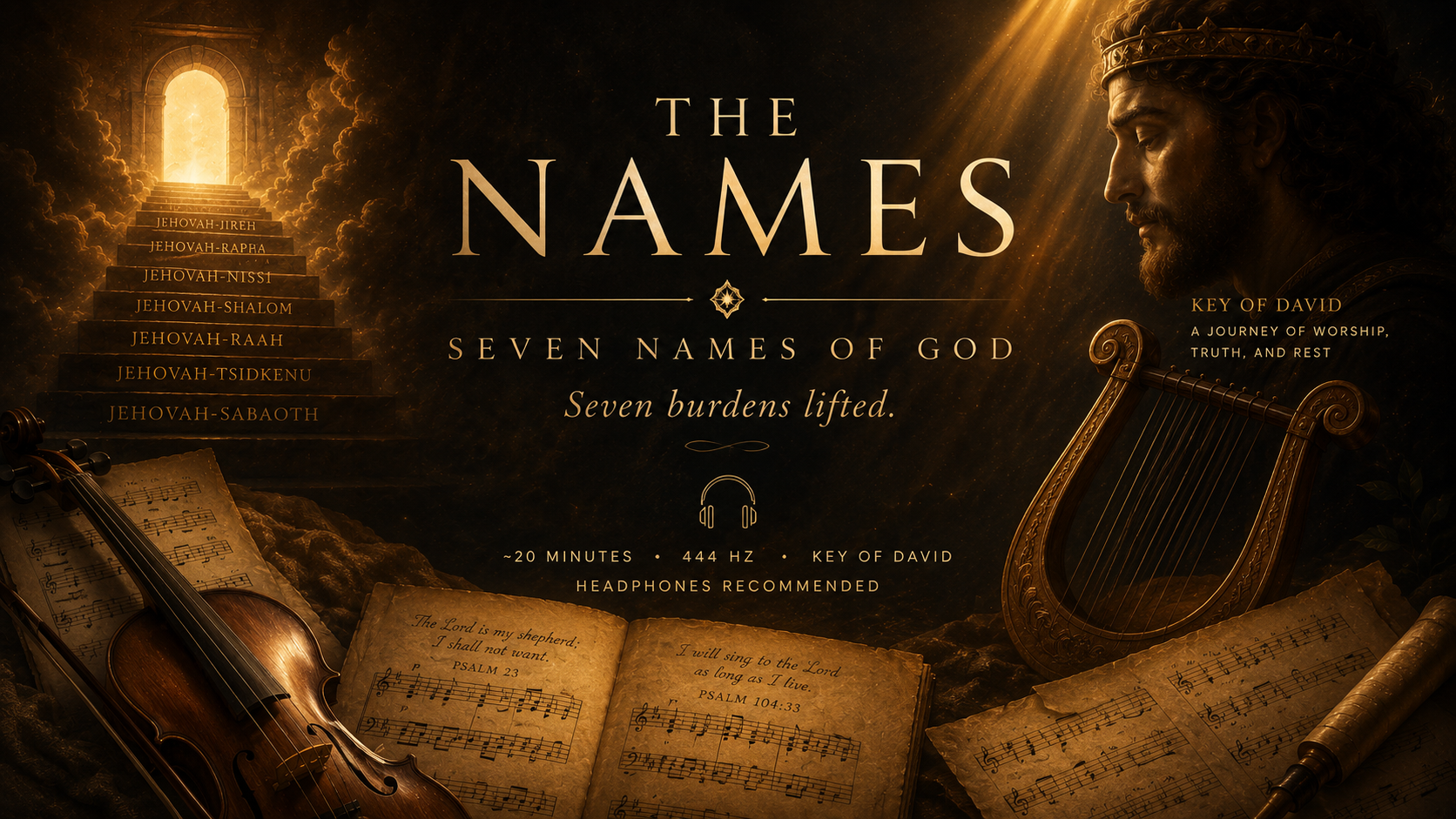
The Names · A New Session
Seven names of God.Seven burdens lifted.
A guided ascent through the seven names of Jehovah. As you learn each one, something you have been carrying falls away.
~20 Minutes · 444 Hz · Key of David · Headphones Recommended
Begin free →You were not made to carry it.
The mind will not go quiet. The day sits on your shoulders even after it ends. We used to call this stress — but stress is a thin word for something everyone feels in the body. It is a burden. A weight on the back you have been carrying so long you stopped noticing it was there.
This session does not ask you to add another practice to the pile. It does the opposite. Name by name, it lifts what you are carrying — until you remember who God is, and how near.
"Come to me, all you who are weary and burdened, and I will give you rest."
Matthew 11:28 · NIV
One ascent. Seven names.
Each of the seven compound names of Jehovah was given at a real moment of human need — a man on a mountain, a people at bitter water, a shepherd in a field. At each one, God revealed not a title but His character. Who He is. What He does. How He meets you.
In this session you walk all seven in a single sitting, ascending through the seven veils. And here you do not stay silent. You speak each name aloud — because you do not learn a name by hearing it. You learn it by saying it back.
Name by name.
Two things happen at once. You rise into a fuller knowledge of God — and a heavier version of yourself falls away.
At the seventh name, there becomes here. The Lord is not far. He is within you — and has been all along.
You speak. Even a whisper.
At each name you are invited — never commanded — to speak aloud. This is not a stylistic choice. What the believer speaks has effect: in the spirit, and in the body's own memory.
"The tongue has the power of life and death."
Proverbs 18:21 · NIV
Speaking a declaration aloud lights up the brain in a way that thinking it never does. The body remembers what it has spoken. So as you rise, you do not only hear who God is — you confess it, name by name, until the words are yours. You are my peace. You see me. You heal me. By the seventh name you are no longer worshiping a God who is great and far, but a God who is near, and yours.
Older than its measurement.
Long before modern neuroscience documented what sound does to the mind, a young shepherd in the fields of Bethlehem discovered that the right music could move a tormented soul into peace. Saul was refreshed. The spirit of torment departed. The mechanism is older than its measurement.
Every session is engineered with that lineage in mind — tuned to 444 Hz, scored in the Key of David, built on the harmonics that have settled human hearts through three thousand years of devotion. We did not invent the principle. We refined the application.
"Those who know your name trust in you, for you, LORD, have never forsaken those who seek you."
Psalm 9:10 · NIV
This is not the destination.
The Names is preparation. It is the cleared room before the conversation — the few minutes that make the next twenty possible. Its only purpose is to calm the static and guide you into rest, so you can spend time alone with the Father, the Son, and the Holy Spirit.
The session ends. The encounter is yours to keep.